
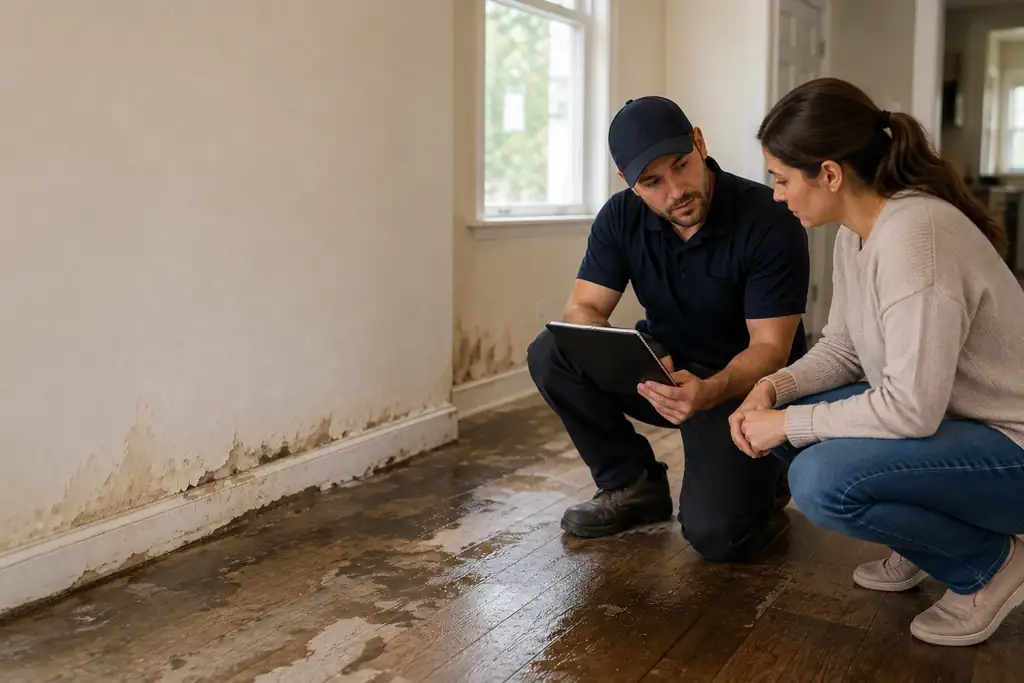
This page is for a new water-damage restoration need. It is intended for homeowners dealing with current property damage after a leak, overflow, flood or other water intrusion—not billing, customer-service or follow-up questions for a company you already hired.
If water is touching electrical equipment, sewage is involved, the structure appears unstable, there is a gas or fire hazard, or anyone may be in immediate danger, leave the affected area and use the water emergency guidance.
What water damage restoration can include
Depending on the loss, a restoration provider may evaluate how far moisture has spread, remove standing water, set drying equipment, monitor moisture conditions, clean affected areas and identify materials that cannot be retained.
Repair or reconstruction after drying may be a separate part of the job. Ask the provider to explain exactly what is included in the written scope.
Water extraction is one part of restoration
Extraction focuses on removing standing or trapped water. Restoration is broader: it can also involve structural drying, moisture monitoring, cleaning, removal of damaged materials and planning for repairs after the structure is dry.
If you only need to understand extraction and drying, see the water extraction guide.
Common situations that may require restoration
- Burst or leaking pipes that wet walls, floors, cabinets or insulation.
- Malfunctioning appliances or overflowing household fixtures.
- Water spread across multiple rooms, levels or concealed cavities.
- Flood or storm water that entered the home.
- Sewage backups or other contaminated-water losses that require additional precautions.
If the active source is a household plumbing problem, the plumbing and burst-pipe service path may also be relevant.
What is water damage restoration?
Water damage restoration is the process of addressing a property after unwanted water intrusion. The work can include assessment, water removal, structural drying, cleaning, moisture monitoring, removal of unsalvageable materials and repair planning.
How long does water damage restoration take?
The timeline depends on the amount and type of water, the materials affected, how far moisture traveled and whether demolition or reconstruction is needed. Ask how drying progress will be measured rather than relying only on a fixed number of days.
Is water extraction the same as water damage restoration?
No. Extraction removes water; restoration addresses the broader recovery process, including drying and decisions about affected materials and repairs.
When is professional drying more likely to be useful?
Professional drying is more likely to be useful when water reached drywall, insulation, cabinets, subflooring or multiple rooms, when the loss was not discovered quickly, or when you cannot confirm that concealed materials are drying.
Have enough information to explain the water loss clearly.
You do not need a technical diagnosis. Gather the apparent source, when you discovered the problem, affected rooms and materials, whether water is still entering, contamination concerns and a few photos when safe.
- Ask how moisture will be measured and monitored.
- Ask for the current scope or estimate in writing.
- Ask what extraction, drying, cleanup and repair work are included.
- Ask how additional work is approved if hidden damage is found.
- Verify applicable licensing and insurance before authorizing work.
Describe what happened, where the water spread and whether the source is already controlled.
Call (844) 595-2616Calls may connect you with an independent service provider. Provider availability and service terms vary.Restore Home Help may connect homeowners with independent service providers and may receive compensation if you call through this website. Providers are independent. Restore Home Help does not perform restoration work and does not guarantee provider availability, pricing, insurance coverage or the work performed.
Concerned about mold instead?
Use the dedicated mold service page for mold-removal and remediation information.